Affichage des articles dont le libellé est Petits essais. Afficher tous les articles

mercredi 4 septembre 2013

Punishment and rehabilitation


So Ariel Castro has been found dead by hanging in his cell.

Ever since I was a young man, I've always opposed the death penalty for many reasons, the least being that at the very moment the so-called penalty applies there's no penalty any longer. But the imbecile crowd is pleased and convinced "justice" has been made.

The State, through its officials, knows this isn't a question of "justice" but the ultimate goal of the death penalty is to frighten the masses and asserts its power in the name of protecting the citizens.

But sometimes the ones who've been convicted to death commit suicide and the State isn't at all pleased with this last act of rebellion of individuals.

This is another question I've been asking to myself when I was young (I no longer do since I know the answer): Why aren't death convicts given the possibility at any moment to put an end to their life the way Erwin Rommel was?

The belief is widely propagated that justice is all about punishment and rehabilitation, just that in the case of the death penalty there's no rehabilitation prospect and what is left is the notion of punisment which -precisely- is not a punishment as we've seen above. Talk about "justice" then when there's neither rehabilitation nor punisment.

For the State, death as final outcome of trials isn't the point of course since the whole affair has nothing to do with "justice" but all to do with asserting its terrifying power. For the masses on the contrary, death epitomizes the strictest punishment "justice" can deliver, the one considered the best and most adequate outcome of any judiciary process whereas it is the very opposite, just another tragical farce based on sheer sadism for barbarians.

Most of us believe death is deliverance and in the same time, all those who support the death penalty (many of them believers) consider it to be the most terrible punishment. So which is which then?

(The film is Death by hanging by Japanese flm maker Nagisa Oshima)

vendredi 26 juillet 2013

vendredi 25 janvier 2013

On the (relative) immorality of forgiveness


Every now and then, we meet the recommendation that the only way to find peace and quietness in our hearts and minds is to eventually forgive the offenders who have hurt us through their misdeeds.

I suppose one must have been through some nightmarish experience to tell first hand if the recommendation applies and if it works. Such isn't my case so I can not be assertive on that regard, yet I can imagine some victims finding peace only after they've killed themselves the murderer of their child for example.

As a matter of fact, there aren't that many cases where the issue arises but the rape or killing of children.

So I don't exactly discuss the veracity of the recommendation (let's call it a recommendation) but yet my attention was caught with a specific aspect of it and particularly in association with Kant's teaching re. morality.  

And then I was looking for an image to illustrate the post and I immediately found that one and I knew I was on  something.

I don't know who wrote the sentence in the frame (Ayn Rand?) but it seems indisputable that it posits a very selfish and egoistical basis to forgiveness. One may therefore question the morality of an action which is based solely on the pursuit of personal interest, whatever the circumstances.

Indeed, when we remember Kant' second formulation of the categorical imperative, we cannot but conclude that forgiving for the sake of our own peace of mind is contrary to the formula of humanity as exposed in the Groundwork of the Metaphysics of Moral.
Act in such a way that you treat humanity, whether in your own person or in the person of any other, never merely as a means to an end, but always at the same time as an end.

Excerpt:
A maxim is considered immoral if:

  1. its subjective content is such that it treats the humanity in oneself or others solely as a vehicle towards one's ends.
Could he read the text in the frame, Kant would spin in his grave.

Now, it can be argued that the sentence isn't a maxim or the enunciation of a rule to follow, but merely the honest stating of the ultimate intent of forgiveness, that is treating the other as a means but not an end.

So, even if we forget Kant's theory of morality, I find it hard to deny that the end of forgiveness is basically selfish, selfish in the broadest sense of the word, yet selfish.

Finally, this little questioning may be an indication that morality isn't exactly easy to define nor are the criteria that can be useful in order to tell absolute right from absolute wrong in certain extreme circumstances.

Now, if you think all these meandrous Kantian talks about morality are irrelevant, just consider how it was discussed in an Israeli court 50 years ago.


dimanche 20 janvier 2013

Ayn and Arnie

Last week, this movie poster for Schwarzenegger's latest opus has appeared about everywhere in Parisian metro stations, in the streets of the city, in newspapers etc. And once again I wondered what was the origin of that specific Hollywood genre of cinema based on the notion of the last one, the survivor, the last cop, the last soldier, the last hero etc.

The Last Stand is translated into Le Dernier Rempart in French, but it has to be "the last" something yet.

As a matter of fact, I already had a post on this subject exactly 5 years to this day because of a flick with Will Smith that was just being shown in France by then. I am Legend was the title with the slogan : The last man on earth is not alone

I tentatively proposed an explanation which I knew was a partial answer to my questioning. Besides, I wasn't too assertive about it.

But now, I realise why I failed to fully understand this phenomena 5 years ago, when I still hadn't been introduced to Ayn Rand by Ned. 

For what I've understood, Rand's philosophy is a modernised version of Nietzsche's concept of the Übermensch, an apology of individualism and self reliance as well as an overall distrust of the State and the collectivity. "Trust yourself and nobody else" seems to be the core of the teaching.

I still am flabbergasted to observe what a considerable influence the thesis of Rand have yielded among the American audience and then in America's psyche but apparently, this is a proven fact and all the American visitors I dealt with when I was a street hawker were familiar with Ayn Rand and many of them had read Atlas Shrugged which I had never heard of at that time.

I can't think of any national cinema with a similar genre based on the last something theme, be it in the French, Italian, German, or Korean  movie industries, but then it makes sense since only America has been exposed on an industrial scale to the message Rand brought to Americans. 

Ayn Rand, who apparently was a wise fox, told Americans what they wanted to hear and which, seemingly, was in line with the story of her country of adoption.

What I now realise is that all these last cop, last hero, last soldier, last commander, Last Stand whatever, are reiterated embodiments of John Galt and it certainly plays well with a certain segment of the American audience since Hollywood money makers keep on cashing in with this genre.

And they will until said genre will have ceased to garner money which apparently isn't to happen in the next future, so deep Ayn Rand's influence has penetrated into the American ways of thinking. 

vendredi 4 janvier 2013

Shibboleth

Working for the king of Prussia is one of these hundreds of sayings that exist in French like there are as many ones in about all human languages. That one isn't particularly uncommon, but Ned who's fluent in French may not have met it yet because it's not used that often and also isn't one that is known and understood by all French speakers.  

All these sayings and expressions - let alone proverbs - form some sort of meta-language that gives any society its pure cultural identity, beyond the sheer technicality of the vocabulary and grammar its language is constructed with.

Am I allowed to draw a comparison with the shibboleth of the Hebrews, a word whose pronunciation serves as a definitive marker to distinguish those who are in from those who are out? 

But where the mere pronunciation of the word "shibboleth" suffices to detect a foreigner, it is the very usage of those sayings by non native speakers of any particular language that indicates what could be termed as an illegitimate attempt to break the barriers.

Let me explain: Unless one is completely bilingual, everybody has a certain distinctive native accent when speaking in a foreign language. No need for a shibboleth test, the intonation is here to hear and tell the rest of the audience that a foreigner is speaking.

But when said foreigner employs sayings that are typically associated with a certain cultural group, there is an instant alarm that is set and informs that a foreigner is trying to penetrate the core of a group which cannot recognize him as a full fledged member. I guess it works the same in all societies, be it an Italian speaking Finnish and using specific Finnish expressions because we're all seduced by the mysteries of foreign languages, or a Chinese speaking Japanese (no wait, there are some other problems in that case...).

There must exist some specific Texan sayings (when the cows come home?)  that some one from Illinois (say) may want to use just to show h/h knows. And although it is spoken in English and with a different accent, wouldn't the Texans be tempted to say to the imprudent intruder: "Sir, will you please keep yourself to yourself and even return to where you belong while you're at it?

vendredi 28 décembre 2012

Is this man intelligent?


The other day, Anijo quoted Billy Joel from a link provided by Ned. T'was about people who believe in god, where they dim-witted or what and were they afraid. 

No, they're not answered Joel and also he didn't know whether they are afraid or not  (*).


This exchange is a multiple issues one, but let's concentrate on intelligence and reason though.

Just, what is intelligence (as opposed to being dim-witted)? Among the zillions propositions that have been suggested, what about the ability to put two and two together in as many opportunities as can be and as fast as can be? 

May I suggest another term be introduced, that of "pure reason", the one Mr. Spock is famous for?
 
Now, this is where the notion of reason appears, reason that is the ability to form concepts. Only humans can create concepts of course and this isn't natural at all but a product of the human brain. In that sense, reason is a very young newcomer in the history of the world of animals.

But even if intelligence at its highest is to be found among humans (and sometimes one wonders), we must never forget that we humans are made of emotions, nearly exclusively of emotions and that our intelligence is a very, very minor component of what we actually are on a daily basis. Our deepest and most meaningful self is moulded in emotions as is represented in Maslow's hierarchy of needs

What differentiates reason from intelligence is that the latter doesn't exclude passions (it simply cannot, it lives among them) whereas the former does. This is what Mr. Spock is: pure unaltered reason and unaffected by passions. Pure reason following the rules of logic as enunciated by Aristotles 2.400 years ago.

Now, this is how we can understand why people deemed intelligent can yet be religious ones, buy assault weapons after what happened the other day, vote against their own interest in politics (no, excuse me, these are mere cretins), or hold contradictory opinions on whatever topic. It is our passions (in the academic sense, that of the European XVIIth century) that decide for us, not reason and Mr. Spock is a man of reason, maybe not particularly intelligent since that would mean he's also partly driven by his emotions.

Mr. Spock of course couldn't fall in love, that would be the most unreasonable thing to do. Also, there's no way he could be a religious person.

Indeed, believers aren't necessarily "dim-witted" and this asks the question of why intelligent grown-ups still indulge in believing in fairy tales. Isn't it just because a choice has been made at their place between Jerusalem and Athens as Lev Chestov said?  Or that their passions have made the choice for them?

Needless to say, the character of Mr. Spock is fictitious and always will be: Humans will always be a compound of nearly uncontrollable passions and emotions continuously struggling to keep intelligence and reason under their ruling power. As Schopenhauer said, intelligence is at the service of the Will which is the ultimate master. 

The more prevalent emotions and passions are, the less intelligence and reason have any say. Just consider any love relations. Need I say more?

(*) Methinks they are, all religions being the product of fear.

samedi 15 décembre 2012

Pleased to meet you

I find the propagation of life to be beautiful said the mother after she had given birth to the one who would kill her and then 6 adults and 20 children some 20 years later.


How many among the casualties were against any gun-control policy? And particularly among the parents of the 20 children, how many were pro-gun? These ones are moral accomplices of the shooting of their own children then.

This must come to an end, so we hear every time this sort of tragedy happens but the perpetrator of the next one is already alive and his future victims are alive too, waiting to meet their fate, praying Jesus in their churches that he will protect them.

The killer at one time was as young as today's victims, just who's who, knowing full well that the children who have died today and the survivors as well wouldn't have turned saints but another bunch of the usual mix of good guys and bastards humanity is made of.  

Who can assure that among the 27 victims, none would have killed anybody in one's life, including future soldiers, drivers, rapists whatever?

Those who voluntarily perpetuate life tacitly accept that their children may well be victims of evil whatever the form it dons, they make the wager that yes someone will meet apocalypse on earth but that it will be the neighbour, who just happens to be another human being, but as long as it's not me...

jeudi 6 décembre 2012

Le vrai péché originel


Le péché originel nous sommes supposés tous en porter la responsabilité selon l'Église Catholique.

Il y a à mon sens confusion d'interprétations au niveau historique quant à la genèse du dogme et surtout sa signification profonde.

S'agit-il de signifier que par la connaissance du bien et du mal l'homme s'est distingué définitivement de l'animalité? S'agit-il d'une condamnation de la femme tentatrice qui a incité Adam a désobéir à Dieu? Faut-il y comprendre une condamnation de la sexualité? (La matière vs. l'esprit)

C'est bien là une question de moralité dont il s'agit, le Bien et le Mal n'étant entrés en ce monde que par l'apparition de l'homme.

« C’est pourquoi, comme par un seul homme le pêché est entré dans le monde, et par le pêché la mort, et qu’ainsi la mort s’est étendue sur tous les hommes, parce que tous ont pêché… »

(— Romains,5 , 12)

Au fond, je suis bien plutôt porté à accepter cette explication du dogme.

Écartons la notion de premier homme, il n'y a eu de premier homme que métaphoriquement.

Cependant, si je rejette une quelconque responsabilité de tous ceux qui composent ou ont fait partie de l'Humanité du fait de la faute d'un premier homme imaginaire, je ne peux m'empêcher de penser que sont responsables d'un pêché irrémissible tous ceux qui, délibérément, acceptent et prennent la responsabilité de se reproduire.

C'est un consentement au mal, à la souffrance et à la mort qu'ils donnent ainsi et ainsi s'en font complices et même responsables.

On n'apprendra rien à personne en décrivant ce monde comme un infernal et interminable lieu de souffrances, de douleurs, de chagrins et de méchancetés sans limites. Il n'y a pas de moralité dans une nature peuplée uniquement d'animaux. Si l'on croit percevoir chez eux une trace de moralité, il ne s'agit pour l'essentiel que de projections anthropomorphiques.

Se reproduire, ce n'est pas seulement amener à l'Être un ou plusieurs individus, c'est aussi être à l'origine de la descendance dans les siècles à venir de ces individus qui se compteront rapidement en milliers. Tous destinés à la mort bien sûr, à la souffrance, au manque etc.

Et parmi toute cette descendance, tous victimes d'une façon ou d'une autre, combien de futurs assassins, meurtriers, salauds, dégénérés, crapules de toutes sortes?

La petite Colombienne qui illustre la photo n'est-elle pas d'abord la victime de ses propres parents plutôt que de la nature?

Ilan Halimi a-t-il été victime de ses tortionnaires ou d'abord de ses parents?

Youssouf Fofana est-il sorti du néant?

Vers quelque horizon que l'on tourne sa réflexion, le mal n'a d'autre origine que l'homme.

C'est bien cela à mes yeux le vrai pêché originel : se reproduire et donc dire oui à la vie (façon Nietzsche) quand bien même on est conscient de ce que l'on fait et des conséquences qui ne manqueront pas d'en découler i-né-vi-ta-ble-ment (circonstances aggravantes donc).

Mais que la faute des parents retombe sur la conscience des enfants, non, à moins que ceux-ci plus tard ne réitèrent ce crime.

Mais les enfants, eux, sont innocents.

lundi 5 novembre 2012

On the (relative) morality of the Hiroshima bombing


Ever since I learned of the Hiroshima and Nagasaki bombings I've always wondered why these acts of war were considered the epitome of barbarity and of the utmost inhumanity men are capable of.

Six months prior to the 6th and 9th of August 1945, there has been an aerial raid on Dresden which cost the lives of maybe 200.000 people who perished in an inferno of flames. Most of the same number of Japanese victims in Hiroshima and Nagasaki evaporated within seconds.

The raid over Dresden simply was an act of revenge and retaliation with no military targets and which didn't alter the course of the war nor significantly shortened it.

Before the bomb was dropped over the Japanese city of Hiroshima, an ultimatum was sent to the Empire of Japan which disregarded it and one bomb wasn't enough to make the military clique open its eyes, the generals and politicians accepted that another bomb be dropped and dozens of thousands other civilian casualties perish.

The A. bombings weren't acts of revenge or "punishment" over the Japanese population, they had the moral purpose to make the war come to an end asap and they fulfilled their mission within days.     

The only thing that makes anybody's death different is whether it is or not associated with pain. Is being burnt to death trapped in the back seat of a car after a crash on the motorway or with one's throat slit by some deranged thug a lesser plight that being suddenly atomised? 

It is the enormity of the damages that are caused with one single object that raises fright and terror but at the end of the day, since it is a matter of bringing chaos and destruction, it is just a question of scale.

Paradoxical as it may seem, what happened on August the 6th of 1945 was perhaps the less immoral act of the Second World War since it precisely put an end to said war, a result that the supposedly more "moral" traditional bombings of Tokyo with its 100.000 casualties failed to achieve. 

mardi 2 octobre 2012

Time out

So there was this program on TV the other day, an American one for that matter, where they would explain Einstein's Time-Space theory and once again it was so obvious to me that all that we were told was unfolding in my brain and nowhere else.

They were speaking about the interdependence of time and space and how motion affects the duration of time according to the speed at which any subject may move into space and eventually the conclusion was that each and every one of us has its own specific time because there's nothing like a universal time independent of any subject.

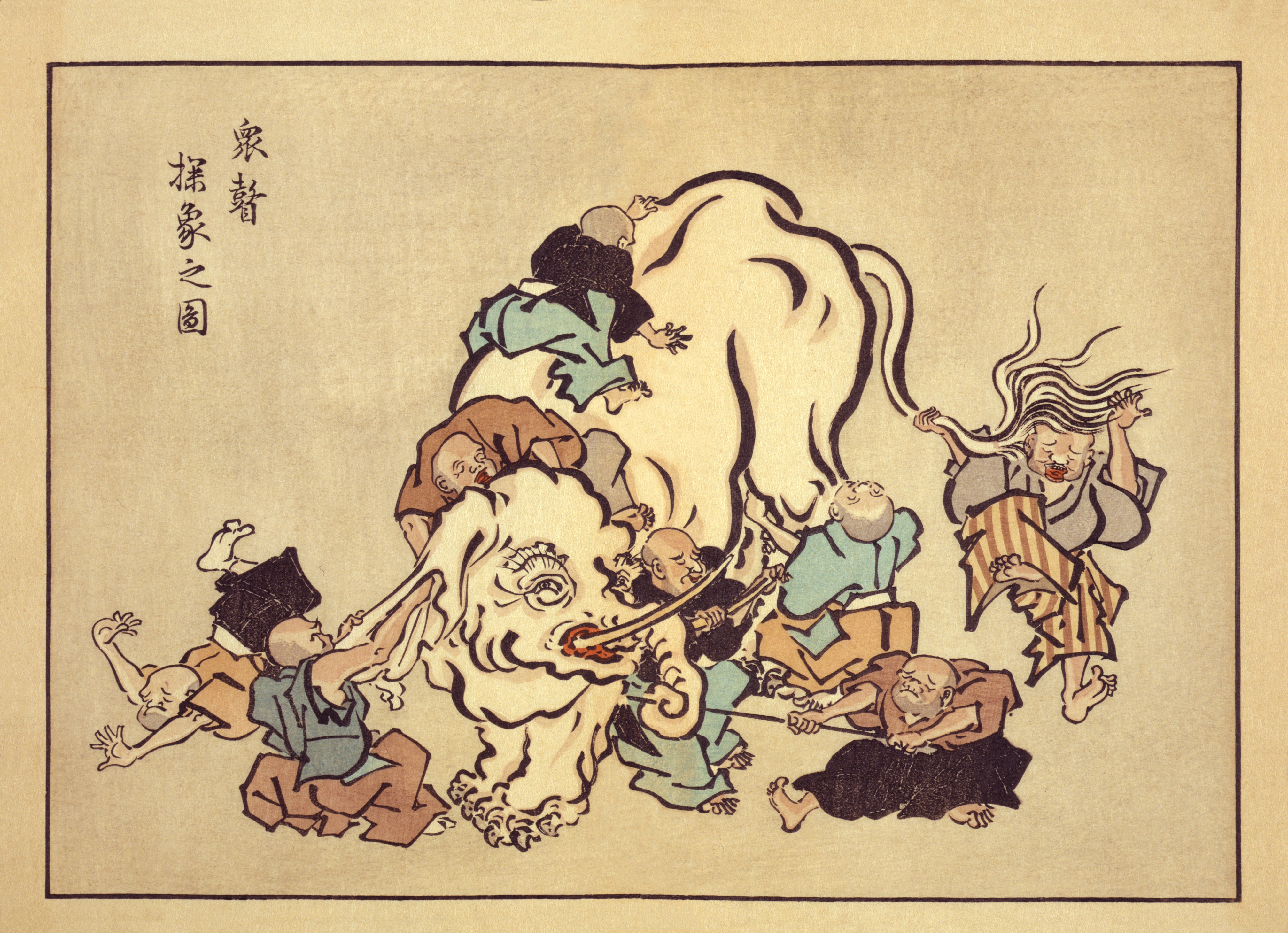
That would have been the theme of the post which eventually I didn't write with the Japanese engraving and the notion of the time gap that exists between individuals who see each others with a near unfathomable but yet existing delay.

While Einstein's theory completely contradicts the Newtonian concept of time as a whole coherent universal medium that is the same to every one, it doesn't oppose Kant's finding that time is an a priori form of our sensibility, what is called our inner sense, as well as space (our outer sense).

The intuition that the world doesn't and cannot exist without a subject in which it can be represented doesn't change one iota of our daily lives and the same goes with Einstein's findings, that is a fact. Yet it doesn't imply that it is irrelevant. Just these notions exist only in our brains where eventually it all boils down to a flux of electrons running wild from one neurone to another one via our synapses. 

Since the idea that the world exists only as long as we're here as mirrors to reflect it is new to some readers, it seems implausible and totally eccentric because it goes against our naive and immediate common sense and perception but are quantum mechanics and Einsteins's theory more likely and easy to understand when taken at face value?

Another way to consider these notions and possibly make them easier to grasp is to take memory as a starting point of our perception of reality. But first, who can seriously deny that memory - which is some kind of time storage - is nowhere else to be found but in our brains? Which also indicates that time is an inner capability of ours and doesn't exist outside us as an independent entity in which we would be bathing. It is not. So when we're talking of time be it yesterday or 3 million light years, these are just data that are being processed by our brains. I look out of my window and I cannot see any three million light years or even three minutes ago. I just can feel  a floating permanent present.

Also, the reason why we haven't the slightest memory of what happened to us when we were some days, some months or even some years old is that our brains weren't developed enough to serve as mirrors to a world which then simply didn't exist. Of course we now can retrospectively reconstruct what was then, just it is the output of our imagination but we simply personally don't know what happened. Our brains then were less developed than stomachs and kidneys, not ready yet to embrace much of any object.

And now we're getting closer to Buddhism with this notion that the world exists only in the frame of a dual relation subject/object which means that when we die, it is not the world that we leave "behind" us, quite the opposite, when we die the only world that exists to us disappears along us and the whole universe collapses as well. And also, the idea that others will continue to live when we're dead is an absurdity and a contradiction since "the others" are part of our own personal world which contains them as objects. When I pass away, I don't leave the world, the word goes with me.

The world as an illusion doesn't concern the present actual world in which my heart beats, my lungs breath and my brain sleeps but relates to the idea that it is eternal and that it was here before I was born and that it will survive me. It won't.


(Charles Trénet ne pensait certainement pas à Kant ni à Einstein quand il a écrit cette merveilleuse perle, mais elle illustre à la perfection ce qui est ici exposé : le monde entier est dans la noix : ouverte la noix le monde disparaît. As simple as that.)

samedi 1 septembre 2012

Two slits on my head

Err... Did I mention I underwent surgery last year? Oh no, not the time when my right forearm was on fire, that was in December. In November I also entered the operating theater and it was my eyelids that were very much on the forefront of my concerns.

Like everybody when our eyes are going to experiment some treatment, I assume we all have some qualms and concerns. Won't the surgeon sneeze at an untimely moment?

So when they woke me up I was relieved to perceive the white gleam of... but of what exactly? All - and not everything - was immerged in an indiscernible white fog and a voice told me (probably, I don't exactly remember) not to worry, I just had been blindfolded and it will last until tomorrow. I hadn't been forewarned.

So the funniest part of the intervention was over and I was brought back to my room where I stayed stuck in my bed with a perf on my left forearm for the next 24 hours.

Oh boy, let me tell you that was like a life changing experience. Being blind isn't precisely like closing one's eyes for a few seconds or even a few minutes just to "see" how it feels to walk in one's apartment without seeing anything.

Lying on a bed on which you are blind and tied, you are then not much more than a mere living object relying 100% on others. Of course forget about Sudoku, cross words, Rubik's cube and their likes. Why didn't you listen to the radio some may ask? Just, try to use any smart phone when you can't see the keyboard, the touches and you don't even know whether you're holding it in the right position...

And one has to be very careful with where the few objects you need are positioned since if you let them drop... well you simply can't retrieve them, they're gone and you're more alone that you previously were.

So basically, you're confronted with your inner thoughts and you discover that isn't much really to keep you busy. 

Since I always have tablets of Lexomil with me I took what it takes to sleep as much as I could. Yet, I felt twice like bouts of anxiety which were quickly overcome since I knew I will be freed at 4 pm the day after. It is possible that I asked the nurses three times which time it was

And also, I shouted in the middle of the night because I needed some bodily fluids to be evacuated and I couldn’t reach the alarm device which was gone somewhere along the bed. That is when the nurse, who was just a voice to me, said: “Look, I put it here” (verbatim).  And it was a reminder of how different it is when one is still present to the world whereas the other isn’t. A world of difference indeed, unless it is a different world... 

Speaking of world... This experience led me once again to the conclusion that the world and the universe too only exist as long as they are perceived by a reflecting consciousness. A process that can happen only with light reaching my brain through these two slits on my head. Behind and covered by said slits, are two drops of water which permit opsins to be kept alive and allow light to activate the cells which in the end create in my mind a representation of the world, and not the world itself of course.

The proposition seems paradoxical I know but yet, there's no mountain and no trees to the blind, no Moon and no planets and no galaxies and no black holes, save metaphorically speaking. The very existence of the world depends on the possibility that it may be perceived with light as the ultimate medium that enables the formation of images upon which we accommodate our skills in order to survive.

And every morning when we wake up, we thoughtlessly rub our two drops of water like they weren’t the very condition that permits the world to exist. The universe is so fragile indeed and it is at our command and most of us don’t realize.


…what he knows is not a sun and an earth, but only an eye that sees a sun, a hand that feels an earth; that the world which surrounds him is there only as representation, i.e., only in relation to something else, the consciousness… 

(to be followed here)

mercredi 1 août 2012

Head is tail and black is white

Depuis une quarantaine d’années l’antisémitisme est le schibboleth de la conscience morale occidentale, la pierre de touche infaillible de la moralité occidentale contemporaine qui autorise la mise en œuvre éhontée d’une aptitude acquise à la culpabilité permettant de distinguer selon un critère exclusif et irréfragable les salauds irrécupérables (les antisémites dont je suis, ceux qui n’adhèrent pas) des autres (ceux qui se taisent).

Être « anti-raciste » c'est un slogan qui se veut universel, tous les hommes, quoique différents, sont égaux (on le croit ou pas, c'est autre chose) et par definition il n'y a pas d'exception et pas d'hommes ou de groupes plus « égaux » que les autres.

Toute adjonction et/ou singularisation est logiquement impossible, il n'y a dans la nature qu'une race humaine avec de nombreuses variantes, et toute différence entre les hommes ne peut être que culturelle et là encore c'est universel, effectivement il y a une multitude de groupes sociaux très différents les uns des autres à tous points de vue.

Nous vivons maintenant dans un registre de valeurs où s'est établie l'équation Juifs = le Bien au sens quasi platonicien which is beyond any scrutiny or critics. Just to be sure, Judaïsm is nothing else but a religion carried on by the purported descendants of a sect of shepherds and fruit pickers living in a small portion of the Middle East some twenty five centuries ago. A religion which is a closed system based on the law of blood contrary to all other religions in the world as far as I know.

The law of blood is the very definition of racism since it doesn't acknowledge someone's merits and value on h/h achievements but only according to the genes h/h biological body is made of. Which is scientifically a complete lunacy of course but the sort of which that makes the same distinction as that the Pures make between them and the Dalits.

Contre le racisme et l’antisémitisme. L’expression est consacrée, l’un ne va pas sans l’autre. Pourquoi pas Contre le racisme et l’anti-sinisme? Ou l’anti-slavisme? Ou l’homophobie? Qu’est-ce donc que cette catégorie tellement différente des autres hommes qu’il faut l’identifier et la singulariser comme telle? Serait-ce parce qu’il s’agit du peuple élu? Mais alors qui est “raciste” dans ce cas si ce n’est ceux qui insistent pour se voir différencier de la communauté humaine?

Qui ne voit que cette association Contre le racisme et l’antisémitisme - qui est maintenant devenue pavlovienne - est très exactement une contradiction interne qui affirme précisément le contraire de ce qu’elle prétend signifier?

The association "against racism and antiSemitism" is an utterly nonsensical one since it pretends to combat racism (what is it? by the way)  on the one hand and protect its very existence and practice on the other hand. What about "against racism and in favour of racism" then?

By mean of some sort of linguistical entryism, Judaism, which is a minuscule racist and excluding sect, has associated itself with a universal message of tolerance and open mindedness. And guess what? Since two or three generations have been continuously brainwashed and immersed in the belief that Judaism = Good per se and criticism of Good = Bad per se, hundreds of millions people in the world in total good faith and no less total ignorance and whose critical thinking has been castrated make theirs a cause which basically exclude them like the Pures exclude the Dalits.  

So when I state that I am an avowed anti Semite what else do I say but that I'm against racism and discrimination? Just that it will be translated like I am an accomplice of Auschwitz et al. Guilt anybody?

Moins les mots sont précis, plus leur signification originelle est diluée jusqu'à être détournée et remplacée par son contraire, plus est facile la manipulation des esprits qui n'ont plus d'appuis sûrs pour étayer un raisonnement ou exprimer des opinions raisonnablement fondées. Which is which when head is tail and black is white?

A conspiracy of silence speaks louder than words

dimanche 22 juillet 2012

Soumission


Le Judaïsme se distingue de toutes les autres religions en ce qu'il est exclusif et fermé sur lui-même. Ne peuvent en effet appartenir à la religion juive que les descendants des bergers et des cultivateurs d'une secte apparue il y a vingt-cinq siècles. Un système social fondé sur un critère génétique, like it or not, that's the very definition of racism.

L'Islam et le Christianisme, pour s'en tenir aux monothéismes, ont pu croître et se développer précisément parce que ces religions sont englobantes, ouvertes à tous et prosélytes. De ce point de vue, ce sont véritablement des religions universelles dans la mesure où elles sont susceptibles d'accueillir toute l'humanité. Raison pour laquelle la plus récente d'entre elles, l'Islam compte plus d'un milliard de croyants quand le Judaïsme qui le précède d'un millénaire n'en compte pas même 15 millions.

L'essence même du Judaïsme, lui interdit toute croissance et expansion. Or toute entité vivante, quelle qu'elle soit, tend à persévérer dans son être et même à se développer si aucune entité d'une puissance supérieure ne s'y oppose (Spinoza as well as Darwin).

La Shoah a paradoxalement servi de déclencheur à cette force latente en toute chose à prendre le dessus sur tout ce qui se rencontre. Bien que légèrement antérieur à la Shoah, le sionisme a trouvé en celle-ci un point d'appui "inespéré" et imparable pour avancer et légitimer ses exigences.

Ce point d'appui c'est la culpabilité que les Sionistes mettent en œuvre depuis 60 ans de façon systématique auprès du monde entier (hormis l'Asie) et tout particulièrement de l'Occident, qui est tenu responsable de ce qui est arrivé aux Juifs et qui doit dès lors intérioriser cette culpabilité.

Nietzsche, avant Freud, a exposé comment la culpabilité était mise en ouvre par les faibles pour dominer les forts et combien elle était térébrante puisqu'elle conduit celui qui en est victime à l'oubli et même à la haine de soi. Il suffit d'observer l'attitude de F. Hollande relativement à la pseudo responsabilité de la France dans la rafle du Vel d'Hiv

Le fait que tous les chefs d'État se sentent tenus, sans même qu'il soit nécessaire de le leur suggérer - tellement ils en ont intégré la pseudo évidence - de porter la kippa quand ils se rendent en Israël ou même dans leur propre pays à l'occasion de telle ou telle cérémonie commémorative, témoigne de la parfaite réussite de cette politique de culpabilisation. 

I have made a quick research but I've failed to find one single pic of W. Wilson wearing a Kippah. And the same goes for Abe Lincoln, the first American Jewish president. Eisenhower, Kennedy? So now it seems it is mandatory for American presidents to wear the kippah out of respect for Judaism and the Jews. Who's next? The Queen of England?


One hundred years ago, Judaism was already here but there was no Zionism, American prezs were mostly Christians from European descent who were probably utterly uninterested with the pretention of the so called "chosen people". But things have changed now. Apparently the process of resorting to guilt in order to submit the other to one's will has worked wonders and as I once read in a British newspaper: In America you can criticize Jesus and God all you want but dare not say anything negative about the Jews.

Indeed, the guit machine is so powerful that as soon as the questions of Israel and Judaism arise, they are mostly met with embarrassed silence. The "at the ready trump card" of the Zionists is to suggest you're an anti Semite (yes, me personally I am an anti-Semite and then what?) and probably a potential accomplice of what happened in Germany 70 years ago.

Actually, not all American are happy with this situation, here, or according to the readers' comments I read in the NYT when the USA/Israel issue is questioned. 

vendredi 13 juillet 2012

I'm not interested

Well, I was 11 when this unassuming person I had never heard of before died and since, I have learned she is perceived by hundreds of millions men around the world as the epitome of beauty, sophistication, sex-appeal whatever. Sorry but I'm not interested and never was.

They'll tell me she's the incarnation of innocence, candour, sensitivity etc. Hmmm... To me she's overall a marketing product in the child-woman/lolita department. Sorry, I'm more interested with the real stuff.

Think of it, there's something Nietzschean with this XXth century axiom that Norma Jeane Mortenson =  Beauty.

Indeed, when we have Plato's concept of ideas, good, bad, beauty etc. in mind, we also remember how Nietzsche taught us that there is no Good or Bad or Beauty per se but some choices have been  made by the (religious) rulers in order to have the masses conform to the will of said rulers.

Not to say this actress has been selected by any religious organisation with the goal of establishing some aesthetic standard but at the end of the day the outcome is more or less the same and in that sense, yes, she has been instrumental.

Fifty years after she's dead her image probably is not as powerful as it used to be in the 60s and 70s but there was a time she was considered the quintessence of female beauty all over the world. My guess is that she also has been an element of the "American Way of Life" policy like Brigitte Bardot was in her time.

Beauty is in the eyes of the beholder as everyone knows and we don't need to be presented with iconic figures that are supposed to teach us good from bad or beautiful from not so beautiful.

Sorry Marylin, sorry Brigitte, I'm not interested!

mercredi 9 mai 2012

Did Joan of Arc sail aboard the Mayflower?

When Leonard Cohen wrote a song called "Joan of Arc" in 1970, I was a bit puzzled that an English speaking Canadian would be interested in this rather distant French historical figure.

For sure, Joan of Arc isn't exactly an everyday object of interest in America, no more than it is in France for that matter, but nevertheless, the few opportunities I've had to meet this character mentioned in the American press or books, it looks like there's some sort of sympathy -if not mild fascination- with this 19 year old maid who contributed decisively to oust the English out of XVth century France.

Ousting the English out of some territories... Hmmm... Is that music to American ears?

Also, Joan, from the very beginning of her self appointed mission, never failed to recall she heard divine voices telling her to deliver France and that God was always her inspiration. Does this religious component of her story contribute to the interest and respect she may enjoy among a certain segment of the American population?

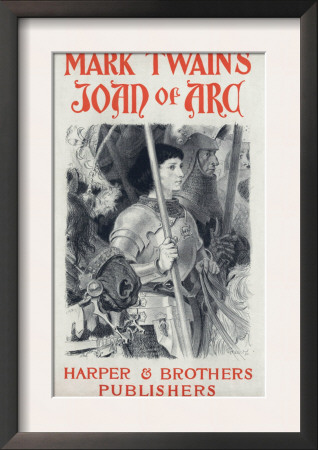
And who would have expected the great American writer, Mark Twain, to write an imaginary biography of the French national heroin?

Now, when I come across Joan of Arc when speaking with English people or when her name is mentioned in the British literature, I can feel some uneasiness. The less she's talked about, the better it seems.

And I was wondering if Americans in general don't make a connection between the story of Joan of Arc and their own experience of English purported intolerance which eventually led their ancestors to leave England and settle in the new world.

lundi 23 avril 2012

The buck stops here

About the only things that I know about Harry Truman are the circumstances of his election and the fact that he was kept out of the picture regarding the A bomb. Other than that, the English Wiki tells me "he was one of the most unpopular men to leave the White House", something that I didn't know.

I haven't done any research to learn what his ranking is among the former U.S prez  60 years after he left office but apparently it looks like an unassuming and inexperienced shirt seller from Missouri could seat in the White House and deal with uncle Joe.

So the first round of the French presidential elections was held yesterday and the socialist candidate (so to say, he's not exactly a trotskyist) may well succeed N.S at the Élysée palace in Paris (nothing's done yet). If Truman could get elected and re-elected in the U.S, why couldn't F. Hollande in France then?

Self satisfaction about how great is the parliamentary system in the West is the key word in our media which have been propagating the notion the world over for about 150 years now. Yes and yet I'm growing more and more sceptical about this.

There's nothing new here but any honest observer with a modicum dose of good faith cannot but notice what an outrageous show of intellectual dishonesty and indecent display of immorality any popular election is - and has to be because addressing the masses is a process which essentially (in its essence) calls for lies, crass vulgarity and vileness.

Things being what they are, let's accept the premises that this lecture of "democracy" is the ultimate achievement of political thought and practise (cough, cough...).

Now, what I find interesting about Truman (for the very little I know about this man) is what seems to have been his motto: The bucks stops here. How much did he stick to this concept of political accountability, I haven't the faintest clue but what I can affirm with both hands on the Koran and the Bible is that N. Sarkozy is the living antithesis of Truman's personal pledge.

The agitated (let's put it that way) pathological liar who's been ruling France for the past five years has to be the world champion of the "It's not me" trump card. This man has brought the practise of lying through his teeth when addressing the electorate to an unprecedented level of professionalism in France. Only with a knife under his throat could he 'possibly' admit that 'perhaps' he may have a tiny portion of responsibility if something somehow went wrong somewhere.

When Operation Eagle Claw turned into a disaster, Jimmy Carter took all responsibility on him for the fiasco which of course was the honourable thing to do for the leader he was. I suppose that was another version of The bucks stops here made real.

Nothing of that sort with Sarko who will make it his personal triumph of any peccadilloes he will have deemed worth taking credit for (with the assistance of the media he has hold on, basically over 80% of the French TV's audience) but will systematically put the blame on others for anything negative that he could be held responsible for.

This walking neurosis is the embodiment of greed and lust for power being allowed to get to the top of the State because "democracy" permits it, all the more so with the help of the constitution De Gaulle devised for France 55 years ago. Thanks for the gift Charlie!

François Hollande certainly seems not fit for the job, probably like Truman in his time but at least absolutely nobody questions his morality or his personal record. If he were to succeed Sarkozy, nothing much will change in the country save, save that there will be much less immorality with the person sitting in the Élysée palace.

Should he eventually not make it, it would be another popular blessing for immorality and depravity. But rest assured that would still be "democratic"!

What a relief!

mercredi 4 avril 2012

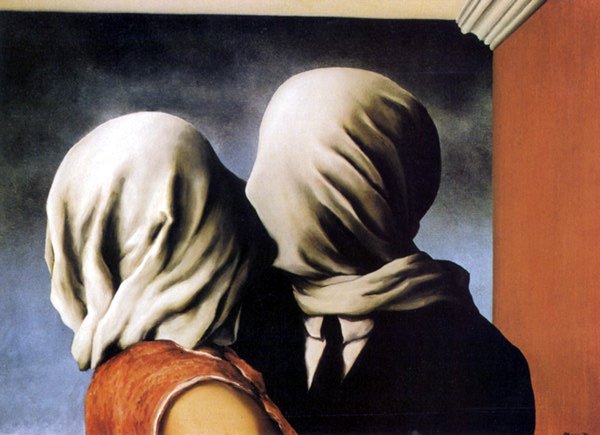
Les amants

Les tableaux métaphysiques de Giorgio de Chirico ne sont pas immédiatement « lisibles » et ne s'adressent pas personnellement au spectateur comme le font ceux de Magritte, à mon sens.

Chacun, pour peu qu'il ait un peu de curiosité et d'imagination, est capable d'essayer de comprendre ce qui lui est présenté comme une interrogation.

Ce tableau de 1928, Les Amants, suscite bien sûr le questionnement. Le titre même que lui a donné Magritte est anodin comme pour toutes ses autres peintures, cela fait partie du jeu. 

Here is a possible interpretation of the painting (a variant of it as a matter of fact) which does'nt say much in my opinion.

I would have chosen "la honte" ou bien "Le zéro et l'infini", (Darkness at noon, in French for whatever reason).

A Schopenhauerian reading is obvious to me. But Charles Sanders Peirce, the American philosopher, may also be of some help, be it only because he once wrote: The entire universe is perfused with signs, if it is not composed exclusively of signs.

Will you play the game, be it only in petto ?

lundi 19 mars 2012

On a ga-gné! On a ga-gné!


« Democracy is the worst form of Government except all those other forms that have been tried from time to time ». 65 ans que Winston Churchill a prononcé cette phrase devenue la référence définitive qui valide le système parlementaire élu au suffrage universel. Anyway, the same man also said: « The best argument against democracy is a five-minute conversation with the average voter ».

Churchill aimait faire des bons mots et c'en est un mais c'est tout de même un peu court du point de vue philosophie politique. En outre, quelle que soit la citation retenue, le point de vue n'exprime pas une opinion particulièrement positive de ce qu'il est convenu d'appeler « démocratie ». Par ailleurs il faut tenir compte du contexte, 2 ans après la fin du nazisme et en pleine période stalinienne, la réflexion de Churchill revient à dire que la liberté est préférable à la tyrannie.

Certes, mais il est question là des droits de l'homme et non d'une quelconque forme de gouvernement.

Précisément, ce qu'on appelle  « démocratie » me paraît le système politique le plus immoral qui soit et pas seulement à l'exception de tous les autres - il n'y en a d'ailleurs pas tant que ça...

L'immoralité réside d'abord dans l'usage même d'un terme qui ne correspond en réalité nullement à ce qu'il est censé désigner. Le gouvernement du peuple, par le peuple etc. c'est bien joli mais c'est un mensonge, ça n'existe pas tout simplement parce que c'est impossible, les masses seront toujours dirigées par les élites et ça vaut mieux.

Un système politique, social, culturel, quelle qu'entreprise humaine que ce soit, qui est mensonger dans sa définition même est fondamentalement immoral.

Dans la pratique maintenant, puisque la dite démocratie consiste pour le personnel politique à se faire élire par une majorité (50 % + 1) à laquelle elle n'aura jamais de comptes à rendre, il s'agit de s'adresser aux masses par le plus petit dénominateur commun c'est-à-dire à pratiquer la démagogie la plus éhontée.

Chaque période électorale, on le constate encore de nos jours en France et aux E.U, donne l'occasion des plus misérables bassesses des uns et des autres pour attirer à soi le vote des plus bêtes, des plus incultes, des plus naïfs, en activant les réflexes de la peur, de l'égoïsme, de l'envie par la tromperie, la rouerie, la malhonnêteté intellectuelle (si l'on peut dire).

Un système politique qui s'adresse à ce qu'il y a de plus commun et de plus méprisable dans la masse des citoyens est-il moral ?

L'immoralité se situe également au niveau collectif puisque le régime parlementaire oppose deux parties du pays dont l'une pourra s'enivrer de « on a gagné, on a gagné » face à l'autre moitié qui a « perdu ». Ça c'est pour la fraternité et la cohésion nationale... Est-ce moral?

Un système qui met face à face les deux moitié d'une nation et qui permet in fine au gagnant de proclamer « Les Français m'ont élu » alors que seule la moitié plus un petit quelque chose l'a fait est-il moral quand la « minorité » se voit imposer sans recours possible une politique qu'elle a refusée?

La phrase de Churchill a rendu presque impossible de dissocier le régime parlementaire d'avec la liberté et les droits de l'homme alors que c'est loin d'être le cas; autre mensonge quand on songe à Guantanamo ou à la France qui s'est déjà vue condamnée deux fois par la Cour Européenne de Justice pour violation des droit de l'homme...

S'il existait un système politique idéal il serait en place depuis longtemps partout dans le monde. La démocratie parlementaire est un mensonge permanent et un constant déni de « gouvernement du peuple par le peuple pour le peuple », ce que n'est pas le système chinois où les citoyens par exemple ne sont pas montés les uns contre les autres (Divide et impera).

La monarchie éclairée (Maroc peut-être) n'est peut-être pas sans mérites de son côté. Les Marocains sont-ils montés à cran les uns contre les autres, comme le sont les Français pro et contre Sarko ou les Américains pro et contre Obama ou Bush en son temps ?

La phrase de Churchill est un bon mot mais elle participe de la tromperie dont se servent les élites pour faire se tenir tranquille le peuple entre deux élections puisqu'on l'a persuadé que c'est lui qui était l'ultime décideur et souverain.

Et pour parfaire le verrouillage, il en est même qui réclament que le vote soit obligatoire! Les esclaves qui demandent que soit encore plus serrée la chaîne qui les entrave.